
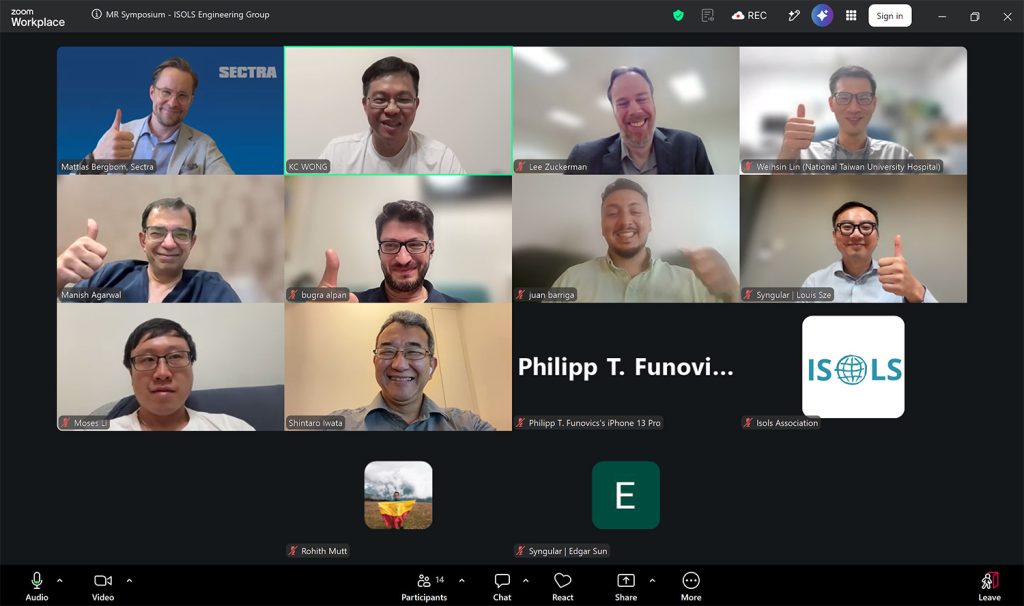
The ISOLS Engineering Group successfully hosted a landmark online symposium on June 26, 2026, dedicated to shaping the future of Mixed Reality (MR) in Orthopedic Oncology. Moderated by Dr. KC Wong and Dr. Lee Zuckerman, the session brought together a diverse panel of stakeholders, including orthopedic oncologists, biomedical engineers, and leading medical technology industries in the field. The discussions bridged the gap between cutting-edge MR technology and practical application, focusing on real-world clinical challenges, integration strategies, and the institutional frameworks required for widespread adoption.
A central focus of the symposium was the clinical utility of MR for navigating complex anatomical and tumor boundaries. Dr. Wei-Hsin Lin and Dr. KC Wong presented cases demonstrating how MR enhances surgical precision, particularly in defining challenging resection margins for infiltrative soft tissue sarcoma and recurrent sarcomas. While acknowledging that MR is in the typical introductory phase of any disruptive innovation, the panel predicted that its path to becoming a standard treatment would be faster than that of navigation or 3D printing. However, to accelerate this timeline and address the current lack of large-scale clinical evidence, Dr. Manish Agarwal emphasized the immediate need for collaborative cadaveric studies and multicenter clinical trials.
From technical and administrative perspectives, the symposium addressed the full ecosystem needed to sustain MR in a hospital setting. Industry experts demonstrated solutions for linking upstream PACS imaging with downstream MR platforms, using AI-assisted workflows for efficient case preparation, and deploying real-time tracking so surgeons can see with “X-ray vision” and improved spatial understanding, thereby facilitating decision-making and precision surgery. To overcome hurdles in clinical deployment and hospital procurement, Wei-Hsin, KC, and Dr. Buğra Alpan emphasized that long-term sustainability requires timely support from local tech partners or dedicated in-house virtual planning and 3D printing labs. Crucially, to help clinical teams work with hospital administrators and navigate regulatory or cybersecurity barriers, the ISOLS Engineering MR Group is preparing official guidelines and consensus documents. Dr. Juan Barriga stressed that these resources will be essential for justifying hospital purchases and streamlining clinical adoption.
Moving forward, thanks to Vienna ISOLS’ support, the group is transitioning these digital discussions into an MR hands-on practical workshop at the upcoming ISOLS meeting in Vienna, September 23-26, 2026, allowing ISOLS participants to experience this cutting-edge technology in orthopedic oncology.
ISOLS engineering group on MR online symposium 26-6-2026 (report prepared by Dr. KC Wong)